
Best prices Special offers for members of the PWE book club The cheapest delivery

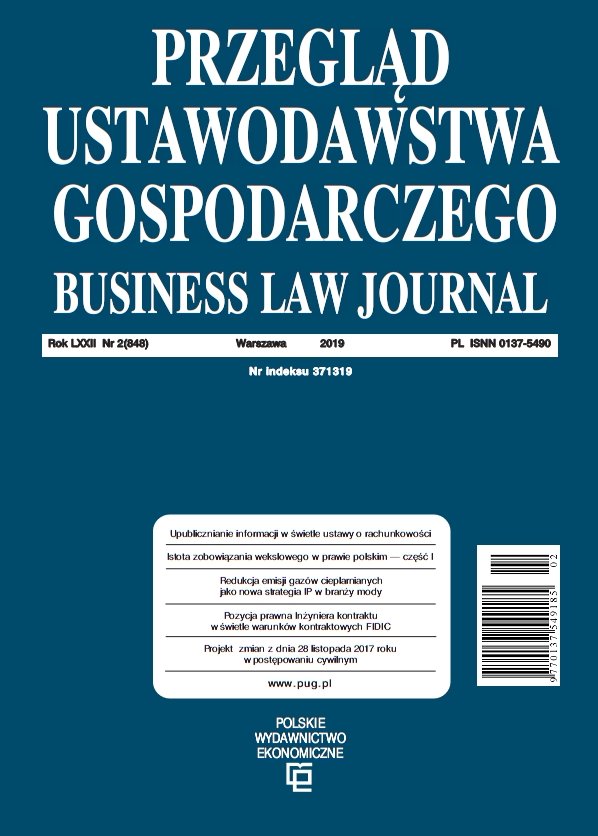
Przegląd Ustawodawstwa Gospodarczego 10/2026

ISSN: 0137-5490
Pages: 76
Publication date: 2026
Place publication: Warszawa
Binding: paperback
Format: A4
Article price
As file to download
5.00 €
Buy article
Price of the magazine number
19.00 €
Annual subscription 2026 (12 consecutive numbers)
225.00 €
180.00 €
Lowest price in last 30 days: 180.00 €
225.00 €
180.00 €
Lowest price in last 30 days: 180.00 €
From number:
Semi-annual subscription 2026 (6 consecutive numbers)
113.00 €
102.00 €
Lowest price in last 30 days: 102.00 €
113.00 €
102.00 €
Lowest price in last 30 days: 102.00 €
From number:
DOI: 10.33226/0137-5490.2026.10.1
JEL: K24, K20

The term “drone” has become one of the most cross-disciplinary and interdisciplinary terms in contemporary law discourses. Traditionally, “drone” is used to identify aerial unmanned vehicles; nevertheless, as it will be demonstrated in this research paper, the same word is helpful to describe some phenomena encompassed by business law too. Navigation and space law, company law, and employment law seem to adopt the concept of drone in order to refer to experiences characterised by three elements: opaqueness, remoteness, and technology. In essence, this contribution aims to demonstrate why and how IT law requires an interdisciplinary analysis of legal notions. From space law to business law through company and employment law, “drones of a feather flock together”.

Keywords: drones; business law; DAOs; securitisations; digital regulation
DOI: 10.33226/0137-5490.2026.10.2
JEL: K23

In resolution procedure, if the administrative court finds that decisions issued by the Bank Guarantee Fund are flawed, it is not authorised to declare the act as invalid and remove it from the legal order. The court may only declare that it was issued in violation of the law, which gives rise to claims for compensation. For this reason, it is particularly important to understand the conditions for issuing such a decision. In the author’s opinion, a broad interpretation of these conditions is supported by an analysis of the legal norms applied in the judicial review of restructuring-related decisions, carried out in the context of doctrine and case law, as well as axiological and systemic arguments. These grounds relate to decisions that are legally flawed, as made in limited, single-instance administrative proceedings, and the only means of appeal is a complaint to the administrative court, which, moreover, may not overturn an unlawful decision. This points to the necessity of securing, to the highest possible degree, protection for the entity adversely affected by the consequences of the defective act.

Keywords: resolution procedure; Bank Guarantee Fund; judicial review of administrative decisions; types of violations of law
Download article
DOI: 10.33226/0137-5490.2026.10.3
JEL: K20, G33

This article examines the impact of economic operator’s bankruptcy and restructuring on participation in public procurement proceedings. It contains the analysis of the provisions of Public Procurement Law (the current and previous) addressing economic operator’s bankruptcy and restructuring as grounds for exclusion, including in light of Directive 2014/24/EU. These regulations are compared with the features, purpose, and course of insolvency proceedings. The conclusion is that the current grounds for exclusion related to bankruptcy and restructuring of the economic operator do not fully reflect the various variants of insolvency proceedings, which may result in the exclusion of a reliable economic operator from the proceedings.

Keywords: lic procurement; exclusion grounds; bankruptcy; restructuring
Download article
DOI: 10.33226/0137-5490.2026.10.4
JEL: K34

The aim of this study is to analyse the relevant legislation in order to identify the legal provisions that set out the founder’s obligations regarding the determination of the tax base for the income of a foreign controlled entity that is a family foundation. The dogmatic analysis of the provisions of the ATA Directive and the Personal Income Tax Act made it possible to conclude that the provisions of the ATA Directive regulating the method of determining the basis for calculating the tax when taxing the income of a controlled foreign company have not been fully correctly transposed into the Polish legal system.

Keywords: family foundation; foreign controlled entity; cfc; dividend; gain
DOI: 10.33226/0137-5490.2026.10.5
JEL: K23, K33, K35, K38, K41

The article examines the problem of the differentiation of the legal situation against consumer debtors in bankruptcy proceedings under the conditions of court procedure digitisation. In light of European Union law, especially Art. 47 of the Charter of Fundamental Rights of the EU and objectives of the Directive 2019/1023, it has been proventhat EU-consistent interpretation oblige national courts to interpret bankruptcy law provisions in a way that ensures equal access to the court at all stages of the proceedings. A dogmatic and systemic analysis of Articles 491²(3) and 216aa of the Polish Bankruptcy Law leads to the conclusion that the right to submit pleadings in paper form should also be granted after the declaration of bankruptcy. The findings have practical significance – enabling courts to eliminate interpretative ambiguities without legislative amendments, thus strengthening the protection of fundamental rights and the efficiency of the justice system.

Keywords: bankruptcy law; EU-consistent interpretation; principle of legitimate expectations; right to a court; Directive 2019/1023
DOI: 10.33226/0137-5490.2026.10.6
JEL: H57, K22, K24

The dynamics of change in the international arena have compelled the European Union and its member states to re-evaluate previous principles regarding the inevitability of trade globalisation and the reliability of supply chains. It is evident that there is a prevailing tendency towards the establishment of strategic autonomy, of which cybersecurity constitutes an integral component. Those obliged to apply public procurement regulations have an important role to play in ensuring strategic autonomy. Fundamental principle of this regulation is the equal treatment of actors within these procurements. However, this principle may conflict with attempts to ensure strategic autonomy. The article’s analysis focuses on three institutions that allow for exceptions to this principle: local content requirements, the preference for EU-based vendors, and the selection of offers based on bidder experience. These exceptions are analysed within the context of achieving maximum cybersecurity within the broader pursuit of strategic autonomy.

Keywords: strategic autonomy; public procurement; cybersecurity; supply chain; European Union
DOI: 10.33226/0137-5490.2026.10.7
JEL: K23, K32

This paper pursues a twofold objective: to examine whether the national regulatory frameworks of the Czech Republic and Hungary concerning energy sharing and Energy Communities (ECs) align with EU law, and to assess the extent to which they support distributive justice (DJ) principles, especially through ensuring the vulnerable consumers’ participation. On that basis, recommendations for amending the regulations on ECs and energy sharing in the Czech Republic and Hungary, with guidance transferable to other EU Member States are formulated. The thesis of the paper is that, despite the formal transposition of the EU framework on ECs and energy sharing, Czech and Hungarian legislation only partially realise distributive justice goals, thereby constraining equitable and meaningful vulnerable consumers’ participation. The authors conducted their research using dogmatic-legal and comparative methods. The study highlights regulatory gaps and recommends amendments.

Keywords: Energy Communities; energy sharing; distributive justice; vulnerable consumers; energy justice
Download article
DOI: 10.33226/0137-5490.2026.10.8
JEL: K10, K24, K38

On 27 February 2025, the Court of Justice of the European Union delivered its judgment in Case C-203/22 concerning the right to obtain information about decisions based solely on automated data processing. The Court held that Article 15(1)(h) of the GDPR grants data subjects the right to receive explanations regarding the principles and procedures of automated data processing that led to a specific decision. At the same time, the CJEU emphasised that controllers cannot arbitrarily refuse to fulfil this right on the grounds of protecting trade secrets; any potential limitations must result from an individual balancing of interests conducted by a supervisory authority or a court. The purpose of this article is to analyse the Court’s reasoning, to discuss how controllers can meet requests for explanations regarding automated decision-making in light of the standards set by the judgment, and to assess the impact of the Court’s interpretation on the application of the right to explanations under Article 86 of the AI Act.

Keywords: RODO; sztuczna inteligencja; AI Act; prawo do uzyskania wyjaśnień; decyzje
Download article
Odbiór osobisty 0 €
Inpost Paczkomaty 3 €
Kurier Inpost 4 €
Kurier FedEX 4 €
Free delivery in Reader's Club from 59 €