
Best prices Special offers for members of the PWE book club The cheapest delivery

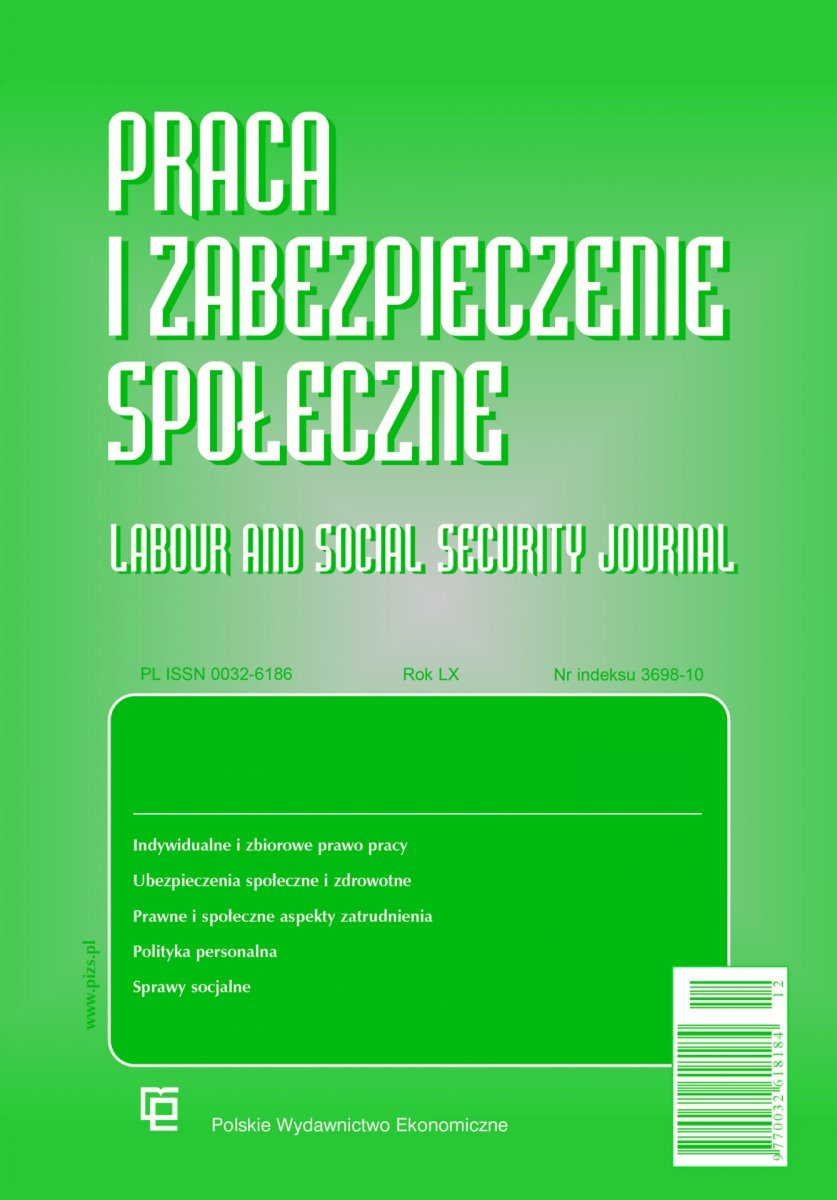
Labour and Social Security Journal 05/2026

ISSN: 0032-6186
Pages: 72
Publication date: 2026
Place publication: Warszawa
Binding: paperback
Format: A4
Article price
As file to download
5.00
Buy article
Price of the magazine number
19.00
Annual subscription 2026 (12 consecutive numbers)
225.00 €
180.00
Lowest price in last 30 days: 180.00
225.00 €
180.00
Lowest price in last 30 days: 180.00
From number:
Semi-annual subscription 2026 (6 consecutive numbers)
113.00 €
102.00
Lowest price in last 30 days: 102.00
113.00 €
102.00
Lowest price in last 30 days: 102.00
From number:
DOI: 10.33226/0032-6186.2026.5.2
JEL: K31

The article concerns the issue of abuse of non-employee forms of gainful employment (civil and economic law) in order to circumvent labor and social security regulations (social and health insurance) for financial gain (wages and contributions), which distorts the social and econom­ic function of employment and leads to the inefficiency of social protection at both the individual and collective (community) levels. This phenomenon has been defined as a state of illegality (iniquity) in employment relations, with an explanation of its essence and consequences. Next, considerations are made regarding the freedom to choose the basis of employment, which is closely related to the final remarks on maintenance, in particular due to the universality of the constitutional approach to the princi­ple of freedom of work, the existing (diverse and equiv­alent) forms of gainful employment (the free nature of employment). However, it was stipulated that this should be accompanied by the inclusion of civil law contracts and non-agricultural economic activity in legal solutions aimed at harmonizing employment conditions (i.e., labor pro­tection within the meaning of Article 24 of the Constitu­tion of the Republic of Poland) and social risk protection with the standard of rights and obligations existing in the sphere of employee employment.

Keywords: illegality (iniquity) of non-employee employment; freedom of work; labour protection; social insurance (security); social risk protection
DOI: 10.33226/0032-6186.2026.5.3
JEL: K31

The Constitution not only establishes the necessity of a civil service in Poland but also defines its purpose. It also emphasizes its importance for the proper functioning of the state. The adopted regulation has far-reaching conse­quences, in particular forcing the legislature to introduce solutions that will enable the implementation of the gener­al provisions of the Constitution in the practical operation of the civil service. This article presents critical observa­tions regarding the current legal status resulting from the Civil Service Act, with particular emphasis on solutions that cannot be considered anything other than unconstitu­tional. The author also proposes actions that could change this undesirable state of affairs.

Keywords: civil service; constitution; government administration; prime minister
DOI: 10.33226/0032-6186.2026.5.4
JEL: K31

Non-standard forms of work are characterised by a shift of normative risk to the worker, while in the employment rela­tionship it should be the employer who bears this risk as the organiser of work. The article argues that social dialogue can be an adequate means of shaping the allocation of risk in atypical employment. The author shows how collective mechanisms already frame this risk to some extent, and provides ideas on how they can be further used in this area to provide adequate protection for workers. In this part of the study, the author uses specific examples drawn from EU and Polish law to analyze the extent to which the potential of these instruments has been utilized.

Keywords: social dialogue; collective bargaining; risk; non-standard forms of work; atypical employment
DOI: .33226/0032-6186.2026.5.5
JEL: K31, K32, K38

The article presents an analysis of the spillover effect of do­mestic violence into the workplace, highlighting it as a sig­nificant challenge for labour law. The first part of the article describes the mechanisms through which domestic violence impacts the victim, their colleagues and the organisation. This includes a decline in productivity, absenteeism, staff turnover and health and safety risks, among other things. Next, the importance of ILO Convention No. 190 and Recommendations No. 206 in establishing universal legal standards in this area is discussed. Further in the article, the Polish legal system is addressed, with emphasis placed on the employer’s duties to counteract discrimination and mobbing and to ensure safe working conditions. The author also presents examples of good practices from other legal systems, including paid leave, flexible work arrangements, and employment protection. The role of social organisa­tions and trade unions in mitigating the effects of violence is then discussed. The analysis concludes with a postulate con­cerning the need to shape appropriate limits of the employ­er’s responsibility for monitoring and mitigating the spillo­ver effect of domestic violence into the work environment.

Keywords: domestic violence; violence; OHS; Polish legal system; Convention 190; Recommendations 206; International Labour Organization; mobbing; discrimination
DOI: 10.33226/0032-6186.2026.5.6
JEL: J71, J83

This article aims to show the specific nature of discrimina­tion based on more than one prohibited ground and the problems that arise in combating this phenomenon, us­ing the example of the European Union (EU). Research in this area is based on the hypothesis that it constitutes a specific form of unequal treatment in many respects and that it still poses a significant challenge for EU law and practice, despite some changes made in this area, particu­larly in legal regulations on gender equality. Furthermore, the approach of the Court of Justice of the European Un­ion (ECJ) towards this type of discrimination is puzzling. It typically contributes to raising standards of protection against unequal treatment. However, in this case, it does not, usually considering the criteria for discrimination sep­arately. As a result, the article first presents the challenges associated with defining and applying the concept in prac­tice. Then, it discusses and compares the regulations of EU secondary law that address discrimination based on more than one prohibited ground. The next section analy­ses the cases before the Court of Justice in which this form of discrimination has been invoked. The final remarks fo­cus on the most crucial challenges still faced by both the EU and its Member States, which are required to imple­ment the provisions of the relevant directives, including the directive on pay transparency (2023/970).

Keywords: cumulative discrimination; intersectional discrimination; comparator; directive on pay transparency (2023/970); Parris and Islamic headscarf cases
DOI: 10.33226/0032-6186.2026.5.7
JEL: G18, G28, G51, J32, K15

Clear and comprehensive information about retirement products and their key features is essential for individuals choosing an additional pension plan. Such choices affect the amount of capital accumulated and the adequacy of benefits in old age. These decisions are inherently difficult because they involve a long-term horizon and an uncer­tain future. The complexity of the supplementary pen­sion system adds to the challenge. Individuals often lack the knowledge and access to information needed to avoid mistakes. The article aims to identify the information ob­ligations of financial providers toward participants in sup­plementary pension plans in Poland. We assess their scope and examine whether they provide real protection through information, both before signing a contract and during the savings period.

Keywords: pension; supplementary pension schemes; individual retirement accounts; pension information; information asymmetry
DOI: 10.33226/0032-6186.2026.5.8
JEL: K31

To date, the Supreme Court’s case law has not given ex­tensive consideration to the issue of succession to property rights arising from an employment relationship following the death of an employee. The relevant academic liter­ature also addresses this issue rarely and, when it does, only in passing. This gap is filled by the latest resolution of the Supreme Court (II PZP 3/26), which not only clarifies the rules governing this issue under labour law, but also sets out the reasons for and functions of the differences between these rules and the rules of inheritance based on civil law. This paper is devoted to a broader discussion of this case law.

Keywords: employee; death of an employee
DOI: 10.33226/0032-6186.2026.5.9
JEL: K31

On 17 March 2026, the Court of Justice of the Europe­an Union, in its judgment in case C-258/24 Katholische Schwangerschaftsberatung, held that a religious organiza­tion may not terminate an employment relationship with an employee solely because they have left the Catholic Church, if at the same time it permits the employment of non-Catholics to perform identical duties. The judgment was delivered against the backdrop of a long-standing in­terpretative dispute between the Court of Justice of the European Union and the Federal Constitutional Court of Germany concerning the balancing of conflicting con­stitutional values: on the one hand, employees’ right not to be discriminated against on the grounds of religion or belief, and on the other hand, the right of churches and religious organizations to self-determination, in particu­lar with regard to defining ethical principles and shaping employees’ duties of loyalty.

Keywords: Directive 2000/78/EC; equal treatment in employment and occupation; occupational activities carried out in churches or other organizations the ethos of which is based on religion or belief; occupational requirements; acting in good faith and with loyalty to the ethos of the church or organization; difference of treatment on grounds of religion or belief
Odbiór osobisty 0 €
Inpost Paczkomaty 3 €
Kurier Inpost 3 €
Kurier FedEX 3 €
Free delivery in Reader's Club from 47 €