Best prices Special offers for members of the PWE book club The cheapest delivery

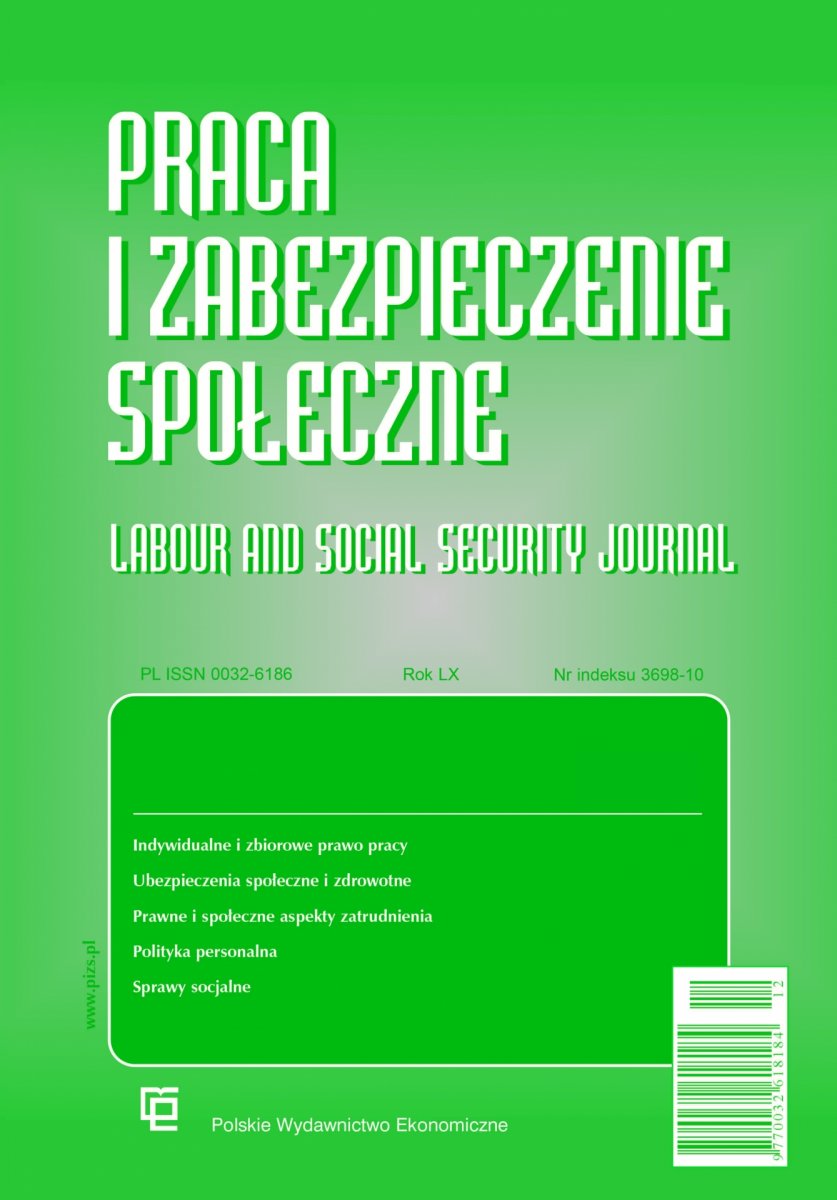
Labour and Social Security Journal 07/2026

ISSN: 0032-6186
Pages: 76
Publication date: 2026
Place publication: Warszawa
Binding: paperback
Format: A4
Article price
As file to download
5.00 €
Buy article
Price of the magazine number
19.00 €
Annual subscription 2026 (12 consecutive numbers)
225.00 €
180.00 €
Lowest price in last 30 days: 180.00 €
225.00 €
180.00 €
Lowest price in last 30 days: 180.00 €
From number:
Semi-annual subscription 2026 (6 consecutive numbers)
113.00 €
102.00 €
Lowest price in last 30 days: 102.00 €
113.00 €
102.00 €
Lowest price in last 30 days: 102.00 €
From number:
DOI: 10.33226/0032-6186.2026.7.2
JEL: K31

The analysis examines the relationship between the defi­nition of an employee in the Polish Labour Code and the definition of a platform worker, which can be interpreted in accordance with the requirements of Directive (EU) 2024/2831 of the European Parliament and of the Council of 23 October 2024 on the improvement of working condi­tions on platforms. Consequently, the question is whether the implementation of the aforementioned directive jus­tifies extending the presumption of an employment rela­tionship to typical employment.

Keywords: employee; platform worker; direction and control; pre¬sumption of the existence of an employment relationship
DOI: 10.33226/0032-6186.2026.7.3
JEL: H53, J08, J21, J65, K31, K33

This article characterises the legal framework of unemploy­ment benefit under the Act of 20 March 2025 on the La­bour Market and Employment Services. While building on established solutions, the regulation introduces numerous modifications, the most significant of which are analysed herein. These structural changes imply a hypothesis that the benefit’s role within the unemployment assistance system has shifted significantly, potentially affecting the guarantees of both the right to work and the right to social security. Therefore, an additional research objective is to verify this hypothesis. Where the legal framework remains unaltered, it is justified to rely on the existing doctrine and judicial practice. Finally, this analysis serves to formulate de lege ferenda postulates.

Keywords: unemployment benefit; right to work; right to social security; social risk; unemployment
DOI: 10.33226/0032-6186.2026.7.4
JEL: K31

European undertakings send, and will undoubtedly con­tinue to send, employees to other Member States in order to provide services to local entities. Such employees, tem­porarily assigned by their employers to work in another Member State, are referred to as posted workers. How­ever, the posting of workers is only ostensibly a matter as straightforward as a specific form of labour mobility whereby an undertaking, in exercising its freedom to pro­vide services, relies on employees engaged in one Mem­ber State to perform work in another. The issue becomes considerably more complex when one takes into account the interrelationship between the posting of workers and the institution commonly referred to as a “business trip”: a concept not recognised as such under EU law, albeit widely regulated and applied in the domestic legal systems of certain Member States. The primary objective of this study is to identify and analyse the legal challenges aris­ing in the field of workers’ mobility within the European Union. The analysis commences with an outline of the general legal framework established under EU law, with particular emphasis on the regime governing the posting of workers. Building upon the current state of the art, spe­cial attention is devoted to the conceptual and normative examination of the “business trip”, an institution absent from EU law and not uniformly recognised in the domes­tic laws of all Member States. In this context, the study examines national labour law provisions concerning “busi­ness trips” or analogous institutions in Bulgaria, the Czech Republic, Estonia, Latvia, Poland, Slovakia, and Slovenia.

Keywords: posting of workers; secondment; workers’ mobility; business trip; labour mobility

DOI: 10.33226/0032-6186.2026.7.5
JEL: H55, I38, J18, J11

The article examines the hierarchy of threats to societal se­curity in Poland and analyses how their salience varies across socio-demographic groups. The study employed a diagnos­tic survey using the CAWI technique on a parameterised sample of adult residents in an online setting. Findings indi­cate the primacy of threats closely tied to everyday experi­ence (existential and health-related), while more distant is­sues, such as technological transformations or demographic processes, rank lower. Statistical tests confirm a selective pattern of differentiation. Gender, age, educational attain­ment, and marital status structure priorities in distinct ways, whereas the effects of place of residence and most regional differences are limited. The conclusions translate into pub­lic management recommendations, including combining universal baseline safeguards with tailored interventions for specific risk groups and maintaining continuous monitoring of perceived threats to inform social policy design.

Keywords: societal security; threat perception; threat hierarchy; socio-demographic differentiation; public management
DOI: 10.33226/0032-6186.2026.7.6
JEL: K31, K38

The aim of this article is to verify the hypothesis that the legislature reasonably provided for the important interest of the service as the basis for dismissing an officer from the Police. Pursuant to Article 41, Section 2, Item 5 of the Police Act, a police officer may be dismissed from service when the important interest of the service so requires. This publication analyzes the concept of the important interest of the service, taking into account the goals and tasks of the Police and the specific status of its officers. The performance of tasks by the Police, which are cru­cial to the proper functioning of the state, undoubtedly requires that its officers be exclusively individuals with appropriate substantive qualifications and physically and mentally capable of serving in uniformed services. The article notes that any disciplinary offense can constitute grounds for dismissal of a police officer due to the impor­tant interest of the service. It also identifies the entities authorized to issue an order of dismissal on this basis and discusses its discretionary nature. The paper also analyzes the significance of the opinion of a company trade union regarding dismissal due to the important interest of the service and the special rights granted to a police officer dismissed from service for this reason. The analysis con­firmed the research hypothesis posed at the outset. The Police Act, therefore, correctly provides for a compelling service interest as a basis for dismissing an officer. Grant­ing a police officer’s superiors the authority to dismiss a police officer due to a compelling service interest un­doubtedly constitutes a significant manifestation of public interest protection and is essential for the proper perfor­mance of police duties.

Keywords: police officer; interest of the service; service relationship; Police; administrative proceedings
DOI: 10.33226/0032-6186.2026.7.7
JEL: K31

The aim of this article is to discuss the impact of the amend­ment to the Labour Code concerning the inclusion of other periods of professional activity in the period of employment on the legal situation of public sector employees, in particu­lar employees of provincial administrative courts, common courts and public prosecutor’s offices. The main research question is to determine the effects of the amendment in question and the possibility for employees to acquire finan­cial entitlements retroactively, as well as the possibility of claiming their payment. The article also includes an analysis of systemic inconsistencies arising from various professional regulations and a proposal to resolve these inconsistencies.

Keywords: length of service; long-service award; seniority allowance
DOI: 10.33226/0032-6186.2026.7.8
JEL: K31, K40

The article examines the implications of counting periods of professional activity towards an employee’s length of ser­vice under Article 3021 of the Labour Code, introduced by the Act of 26 September 2025, where the new rules would mean that the required length of service had already been completed before the Act entered into force. It considers whether periods of self-employment, work under civil-law contracts, or other qualifying forms of professional activity may give rise to the retroactive acquisition of service-re­lated benefits, or to their one-off acquisition on 1 January 2026. The author rejects both interpretations, arguing that Article 6 of the amending Act provides no basis either for the retroactive acquisition of an entitlement or for its au­tomatic acquisition upon the Act’s entry into force. Enti­tlement to a benefit requires both a rule linking a specified length of service to that benefit and a rule requiring the relevant period to be counted towards that length of ser­vice. Accordingly, the subsequent recognition of a period of professional activity for legal purposes does not, per se, give rise to claims relating to the period before the new provi­sions came into force.

Keywords: intertemporal labour law; employee entitlements; length of service; crediting periods towards length of service; jubilee award
DOI: 10.33226/0032-6186.2026.7.9
JEL: K31

The issue of the concurrence of a claim for remuneration for the period of unemployment, pursued alongside a claim for reinstatement (Articles 47 and 57 of the Labour Code), is a frequent subject of court rulings. However, despite the fact that case law has already clarified many contentious is­sues relating to this matter, new factual situations continue to arise that require judicial clarification. One of the judg­ments which addresses a new aspect in this regard is the Supreme Court judgement of 17 March 2026 This paper is devoted to an analysis of the aforementioned judgment.

Keywords: reinstatement; concurrence of claims; remuneration for the period of unemployment
DOI: 10.33226/0032-6186.2026.7.10
JEL: K31

In the judgment of 7 May 2026 in case C-747/22, KH v Is­tituto nazionale della previdenza sociale (INPS), the Court of Justice of the European Union ruled that Italian leg­islation making the grant of a social security benefit to third-country nationals who are beneficiaries of subsidiary protection status conditional upon a ten-year residence requirement is incompatible with EU law. In connection with the challenges facing Polish social policy arising from the increased influx of migrants in recent years, the inter­pretation of EU law can serve as a valuable guide for both the Polish legislator and the courts.

Keywords: indirect discrimination; social protection; equal treatment; beneficiaries of international protection
Odbiór osobisty 0 €
Inpost Paczkomaty 3 €
Kurier Inpost 4 €
Kurier FedEX 4 €
Free delivery in Reader's Club from 59 €