
Best prices Special offers for members of the PWE book club The cheapest delivery

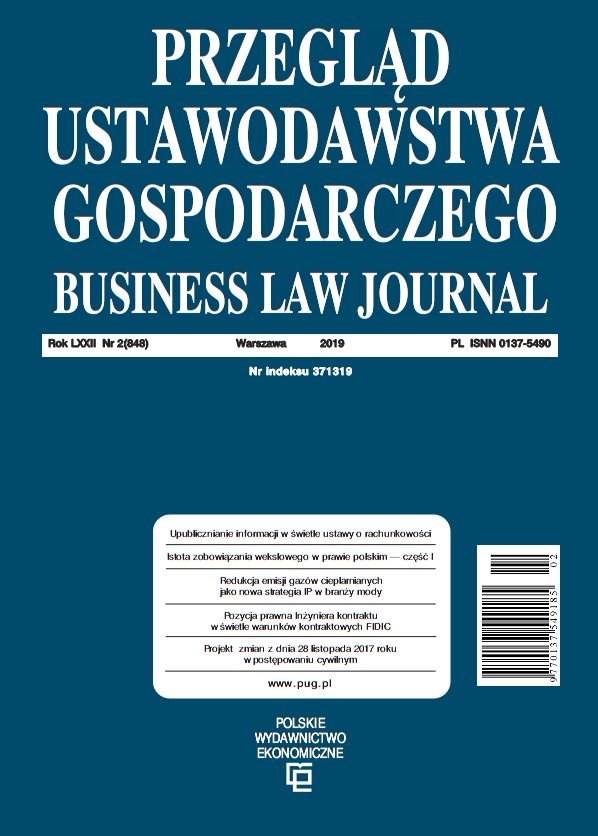
Journal of Business Law 07/2026

ISSN: 0137-5490
Pages: 66
Publication date: 2026
Place publication: Warszawa
Binding: paperback
Format: A4
Article price
As file to download
5.00
Buy article
Price of the magazine number
19.00
Annual subscription 2026 (12 consecutive numbers)
225.00 €
180.00
Lowest price in last 30 days: 180.00
225.00 €
180.00
Lowest price in last 30 days: 180.00
From number:
Semi-annual subscription 2026 (6 consecutive numbers)
113.00 €
102.00
Lowest price in last 30 days: 102.00
113.00 €
102.00
Lowest price in last 30 days: 102.00
From number:
DOI: 10.33226/0137-5490.2026.7.1
JEL: A12

The article focuses on the evidentiary proceedings in the compulsory restructuring of banks conducted by the Bank Guarantee Fund (BFG). It analyses how the BFG collects and evaluates evidence. The article also discusses forms of cooperation with the Polish Financial Supervision Authority (KNF), whose opinions and supervisory data constitute an important element of the evidence, supporting the assessment of a bank’s condition. In addition, it indicates how the evidentiary proceedings ensure a balance between the need for effective intervention and the protection of the rights of entities subject to restructuring. Based on a dogmatic analysis of the law, the article assesses whether the applicable regulations guarantee the correct application of the resolution procedure in accordance with the law and the public interest.

Keywords: evidence proceedings; burden of proof in proceedings before the BFG; cooperation between supervisory and resolution authorities; resolution of banks
DOI: 10.33226/0137-5490.2026.7.2
JEL: G21, H54, H81, Q54

The extent of the damage caused by the flood in 2024 determined the legislator to expand in mid-2025 the catalogue of instruments supporting investors undertaking actions aimed at repairing damaged multi-family buildings. Flood premiums were introduced, granted by Bank Gospodarstwa Krajowego from the Thermal Modernisation and Renovation Fund financed from the state budget. Support is provided at the request of the investor carrying out the renovation project, after the bank has formally verified the application. The aim of the article is to assess the legal regulations regarding the granting of flood premiums and to determine their legal nature. The thesis was formulated and justified about the need to use long-term systemic forms of co-financing the activities of investors bearing the costs of renovation of buildings damaged by floods. When identifying the features of the flood premium, its similarity to a targeted budget subsidy was pointed out, as it is non-repayable and intended for a specific task. The effects of using this investor support instrument so far may constitute the basis for a preliminary positive assessment of the concept adopted by the legislator. The support instrument has not been limited in time and can be used in the event of a flood disaster in the following years.

Keywords: flood disaster; damage; multi-family building; renovation; building owner; non-repayable aid
DOI: 10.33226/0137-5490.2026.7.3
JEL: M14, G34, K20

This article examines the evolving legal nature of corporate social responsibility (CSR) in the European Union (EU), focusing on the textile, clothing, leather and footwear (TCLF) sector. Analysing legal and policy developments, it argues that the legal architecture of CSR has become pluralistic and hybrid. Once conceived as voluntary conduct beyond legal mandate, CSR is undergoing a “hardening” through which soft-law norms and societal expectations crystallise into binding obligations. Frameworks from legal sociology and regulation studies – legal pluralism, reflexive law, autopoiesis, meta-regulation and the regulatory trilemma – illuminate this shift. The analysis highlights EU initiatives such as the Corporate Sustainability Reporting Directive and the Corporate Sustainability Due Diligence Directive, and national laws (France’s Loi de Vigilance, Germany’s Supply Chain Act) that embed CSR into formal legislation. In the TCLF sector, new rules compel firms to internalise social and environmental responsibilities across their supply chains. This hybrid governance seeks to strengthen accountability while preserving flexibility. CSR in the EU has no single doctrinal source or fixed legal status; it exists at the dynamic interface of hard and soft law across global, regional and national levels, raising key questions about normative coherence and the role of stakeholders in enforcing corporate accountability.

Keywords: CSR; soft law; hard law; TCLF sector; corporate responsibility
DOI: 10.33226/0137-5490.2026.7.4
JEL: K12

The regulation of the contractual clause known as lex commissoria raises many doubts in the context of the statutory and contractual right of withdrawal from a contract under the Civil Code. It is not a structurally complex provision; it is sufficient to meet a few specific conditions – a reservation in the contract in the event of the debtor’s delay, when the obligation has not been performed within a strictly defined time limit. In practice, however, this is usually an “accidental” clause, as the parties rarely consciously include it in the contract. This is because, from the creditor’s point of view, it is more advantageous to stipulate a contractual right of withdrawal, but the invalidity of such a provision due to the lack of a time limit for this right means that it is necessary to consider whether we are dealing with legis commissoriae. It is important to note that this is an independent construct, functioning independently of the provisions regulating the two aforementioned rights of withdrawal from the contract.

Keywords: lex commissoria; statutory right of withdrawal; contractual right of withdrawal; delay; time limit for the performance
DOI: 10.33226/0137-5490.2026.7.5
JEL: K34

The article addresses the issue of the limitation period for tax liabilities secured by a compulsory mortgage. Particular attention is paid to the difficulties faced by taxpayers when applying for a certificate confirming the expiry of a tax liability due to the expiry of the limitation period. The article presents, among other things, interpretative disputes concerning the admissibility of examining the limitation period for liabilities in proceedings for the issuance of a certificate. The conclusion of the study is that the lack of clear and effective legal instruments leads to further violations of taxpayers’ constitutional rights, and that a real improvement in their situation requires systemic regulation of the effects of the Constitutional Tribunal’s judgments.

Keywords: statute of limitations on tax liabilities; compulsory mortgage; issuance of a certificate; deletion of a mortgage
DOI: 10.33226/0137-5490.2026.7.6
JEL: K20, K22, K29

This study is devoted to institutes operating within the Łukasiewicz Research Network. It is worth noting in this context that the wide range of activities granted by the legislator to the institutes of the Network also allows them to conduct business activities on market terms. The author of this study has therefore adopted the thesis that an institute of the Łukasiewicz Research Network will be a small or medium-sized enterprise provided that it employs fewer than 250 employees and the annual turnover does not exceed EUR 50 million, or the annual balance sheet total does not exceed EUR 43 million. This article is motivated by substantive considerations, because the title issue is of key importance both for all institutes operating within the Łukasiewicz Research Network, enterprises cooperating with the institutes, and those entities representing the State Treasury that support the development of small and medium-sized enterprises.

Keywords: small or medium-sized enterprise; corporate legal person; commercialization; public aid
DOI: 10.33226/0137-5490.2026.7.7
JEL: K20, K14

Anti-money laundering and countering the financing of terrorism regulations apply primarily to obligated institutions and competent state authorities. This does not mean, however, that these regulations do not also apply to other categories of entities within the framework of specific solutions. The Polish law on this issue introduces and defines the concept of senior management, a group of specific individuals to whom subsequent provisions assign specific responsibilities, crucial both for the proper implementation of the AML/CFT process at the obligated institution and for ML/FT risk in general. Furthermore, the law also provides for far-reaching potential sanctions for this group of individuals. The aforementioned concept of senior management is inherently diverse. Due to the importance of this structure for the AML/CFT system, the author decided to conduct a broader analysis to assess its adequacy for AML/ CFT purposes and the achievement of the system’s objectives, with particular emphasis on the principles and scope of responsibility provided for in Polish law and EU legal acts. In order to answer this question, the author analyses the legal definition, the tasks of individual persons and the resulting roles in the AML/CFT system, as well as the principles of responsibility assigned to this group of persons.

Keywords: AML/CFT; senior management; ML/FT risk; obligated entities
DOI: 10.33226/0137-5490.2026.7.8
JEL: H57

In-house procurement (for own units) has been excluded from competitive public procurement procedures because the contracting authority performs public tasks itself. Therefore, the conditions governing their use must be interpreted strictly, and a mere reference to the relevant legal provisions is insufficient. When announcing its intention to award the contract, the contracting authority is obliged to justify its use. Otherwise, competition in the procurement procedure will be compromised due to the lack of verification by other contractors of the appropriateness and correctness of using the direct award procedure. The latest CJEU judgment of 15 January 2026 in Case C-692/23 AVR-Afvalverwerking confirms the importance of correctly interpreting the in-house exemption, especially from the perspective of protecting competition in public procurement.

Keywords: Directive 2014/24/EU; in-house procurement; capital groups; competition
Odbiór osobisty 0 €
Inpost Paczkomaty 3 €
Kurier Inpost 3 €
Kurier FedEX 3 €
Free delivery in Reader's Club from 47 €