
Best prices Special offers for members of the PWE book club The cheapest delivery

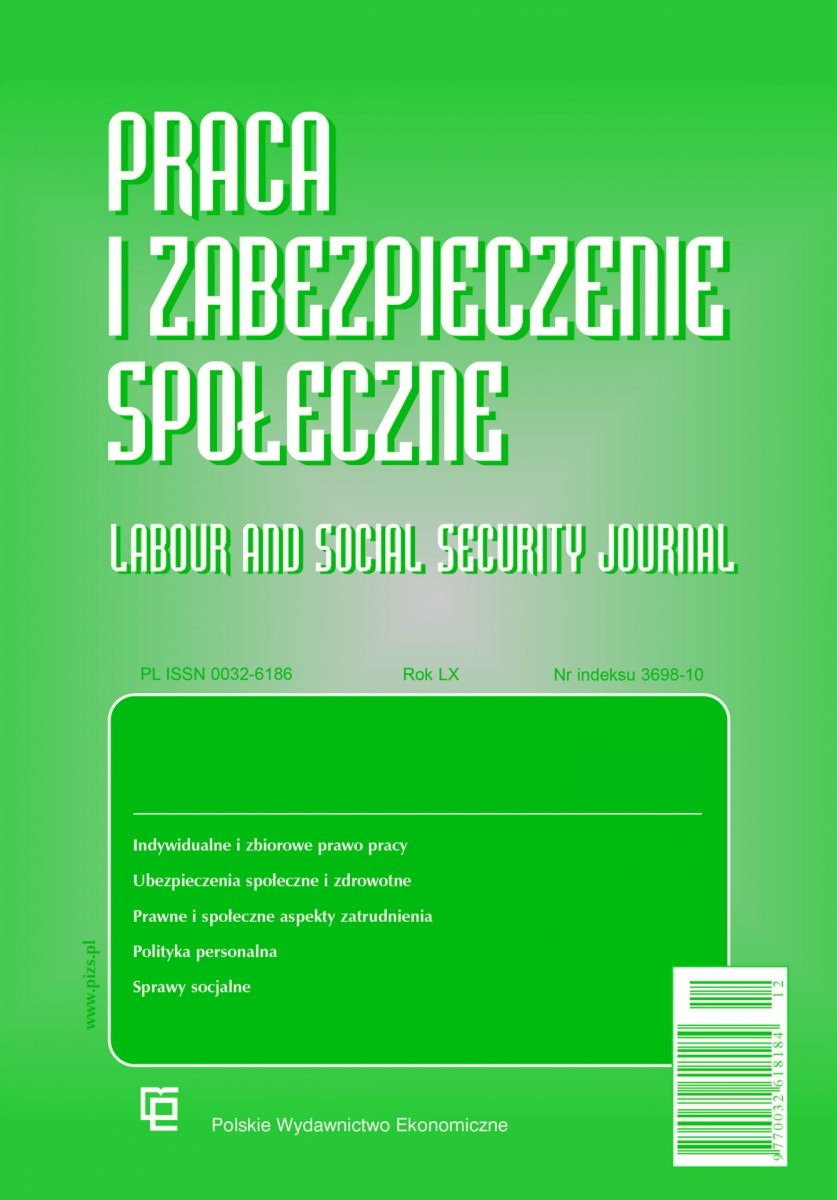
Praca i Zabezpieczenie Społeczne 01/2026

ISSN: 0032-6186
Pages: 60
Publication date: 2026
Place publication: Warszawa
Binding: paperback
Format: A4
Article price
As file to download
5.00
Buy article
Price of the magazine number
19.00
Annual subscription 2026 (12 consecutive numbers)
225.00 €
180.00
Lowest price in last 30 days: 180.00
225.00 €
180.00
Lowest price in last 30 days: 180.00
From number:
Semi-annual subscription 2026 (6 consecutive numbers)
113.00 €
102.00
Lowest price in last 30 days: 101.00
113.00 €
102.00
Lowest price in last 30 days: 101.00
From number:
DOI: 10.33226/0032-6186.2026.1.2
JEL: K31

Recently, the development of artificial intelligence tech­nologies has resulted in more and more widespread auto­mation of the process of collecting biometric data (includ­ing image) and the development of intelligent algorithms. This development is largely supported by the increasingly widespread use of artificial intelligence (AI) in individual identification processes, enabling better and more accu­rate results when processing biometric data. However, the use of various biometric techniques and the processing of data in this way on a mass scale raises legal and ethical concerns and raises questions about the validity and ne­cessity of exercising “biometric control” over society. The processing of biometric data undoubtedly requires the application of increased protection standards because it is associated with an increased risk of violating the rights and freedoms of employees. This risk materializes especially in the context of discrimination and violation of personal rights. However, employers’ rights arising from the em­ployment relationship may not violate the personal rights of employees.

Keywords: protection of employees; personal goods; new technologies; biometric systems; biometric data
DOI: 10.33226/0032-6186.2026.1.3
JEL: J41

The paper reports the findings of a large nationwide survey of couriers and drivers performing their services via digital platforms (sample size: 3,756 individuals). The study was conducted in the early months of 2025 in collaboration with one of the major fleet partners in Poland. Situating the study within the context of the EU Directive 2024/2831 on im­proving working conditions for platform workers, the article seeks to explore potential barriers to the implementation of this Directive within the Polish institutional framework. Drawing on the opinions of individuals completing tasks via platforms, the authors highlight a strong attachment among most respondents to the flexibility provided by plat­form-based work. However, critically examining these per­spectives, the authors aim to situate them within the broad­er concept of worker autonomy, which is more focused on employee well-being than mere flexibility. Viewed through this lens, the freedom to choose working hours appears to be a constrained choice, accompanied by certain costs. One such cost is the ability to achieve high earnings. Drivers and couriers who exercise the freedom to choose their working hours (though not necessarily specific assignments) are not primarily motivated by high incomes. On the contrary, they assume that sustaining oneself financially through this occu­pation under such conditions is challenging.

Keywords: on-demand work; employment contract; contract of mandate; app; Directive 2024/2831
DOI: 10.33226/0032-6186.2026.1.4
JEL: J14, I38, J18

In the face of the dynamic aging of society, the importance of care for dependent older adults is growing. In Poland, the primary burden of this care rests with informal car­egivers – most often family members – whose role, despite its fundamental importance, remains under-recognized within the social security system. This article attempts to analyse the challenges and gaps in supporting this group, pointing to the need to build an integrated support system. In particular, it discusses instruments such as the EU Di­rective on Work-Life Balance, and local solutions, includ­ing the care voucher. In this context, senior policy repre­sents an important area of public intervention that should address the needs of informal caregivers as an integral part of the long-term care system. Social security is understood here in a broad sense – as a system encompassing not only financial transfers but also access to services, legal regula­tions, and mechanisms enabling the combination of car­egiving roles with other life responsibilities. The article is a review based on an analysis of documents and literature on the subject, taking into account social, economic, and cultural aspects.

Keywords: informal caregivers; dependent older adults; social security; senior policy; senior care voucher; work-life balance; long-term care
DOI: 10.33226/0032-6186.2026.1.5
JEL: K31, J24, J83, O33

The paper reports the findings of a large nationwide sur­vey This paper analyses the impact of artificial intelligence (AI) on collective bargaining through the lens of Walton and McKersie’s behavioural theory of labour negotiation. The authors identify four key sub-processes of bargaining distributive bargaining, integrative bargaining, attitudi­nal structuring and intra-organisational bargaining and indicate how AI may reshape each of them. The article highlights both the potential of AI to support fair social dialogue and the risks of deepening inequalities and dehu­manising negotiation processes. It emphasises the current absence of AI as a tool on the side of trade unions, which in turn underscores the need to strengthen institutional safeguards protecting workers’ interests. The analysis con­cludes that the consequences of integrating AI into collec­tive bargaining depend not on the technology itself, but on the principles of transparency, co-governance and the ethical implementation of AI systems.

Keywords: artificial intelligence; trade unions; collective bargaining
DOI: 10.33226/0032-6186.2026.1.6
JEL: H55

The aim of this article is to provide a legal and constitu­tional analysis of Articles 7 and 7a of the Act of 25 June 1999 on Cash Benefits from Social Insurance in Case of Sickness and Maternity, in the context of former soldiers’ entitlement to sickness benefits after the end of active mil­itary service. Special attention is given to situations where incapacity for work arose during military service and con­tinues uninterrupted after its termination. The article ex­amines whether the current wording of these provisions complies with the constitutional principles of equality be­fore the law (Article 32 of the Polish Constitution), the right to social security (Article 67(1)), and the principle of citizens’ trust in the rule of law (Article 2). The analysis demonstrates that the applicable regulations, particular­ly Article 7a, are imprecise and result in inconsistent in­terpretation and application by pension authorities and courts. The article concludes with de lege ferenda propos­als, including the need to clarify the wording of Article 7a by explicitly referring to Article 6(1) of the same Act.

Keywords: social security law; sickness benefit; incapacity for work; professional soldier; social insurance system
DOI: 10.33226/0032-6186.2026.1.7
JEL: K31

This article offers a comprehensive analysis of the legal framework governing the determination of the member­ship size of a multi-employer trade union organization under the amended Polish Trade Unions Act. The author emphasizes that a union’s membership figure is not merely statistical; it defines the scope of the union’s rights, includ­ing representativeness, the number of officials entitled to special protection, and the extent of paid leave from work granted to members of the governing board. The article primarily addresses the analysis of the information obliga­tion incumbent upon a trade union organization, as well as the judicial procedure for verifying the number of its members. The author also addresses issues of territorial jurisdiction and considers the effects of court rulings on the union’s status and entitlements. The article concludes with de lege ferenda proposals aimed at increasing proce­dural uniformity and transparency and maintaining a fair balance between safeguarding trade union rights and pro­tecting employers’ interests.

Keywords: multi-employer trade union organization; trade union; membership size; determination of membership; collec¬tive labour law
DOI: 10.33226/0032-6186.2026.1.8
JEL: K31

The study discusses the Supreme Court’s case law on the credibility of evidence for determining the onset of a men­tal illness resulting in total incapacity for work, in the con­text of the grounds for entitlement to a social pension.

Keywords: social pension; mental illness
DOI: 10.33226/0032-6186.2026.1.9
JEL: K31

This paper is dedicated to the latest judgment of the Court of Justice of the EU on discrimination by association and its implications. In the judgment of 11 September 2025 in case C-38/24 [Bervidi], G.L. v AB SpA, the Court of Justice of the European Union further developed the con­cept of discrimination by association, holding that EU law also affords protection against indirect discrimination by association on grounds of disability to a worker caring for a child with a disability. The Court further held that the employer is required to provide reasonable accommoda­tion in respect of an employee who, although not himself or herself a person with a disability, is subject to such dis­crimination on account of the assistance provided to his or her child with a disability.

Keywords: indirect discrimination; prohibition of discrimination on grounds of disability; discrimination by association; employer’s obligation to make reasonable accommodation
Odbiór osobisty 0 €
Inpost Paczkomaty 3 €
Kurier Inpost 3 €
Kurier FedEX 3 €
Free delivery in Reader's Club from 47 €