
Best prices Special offers for members of the PWE book club The cheapest delivery

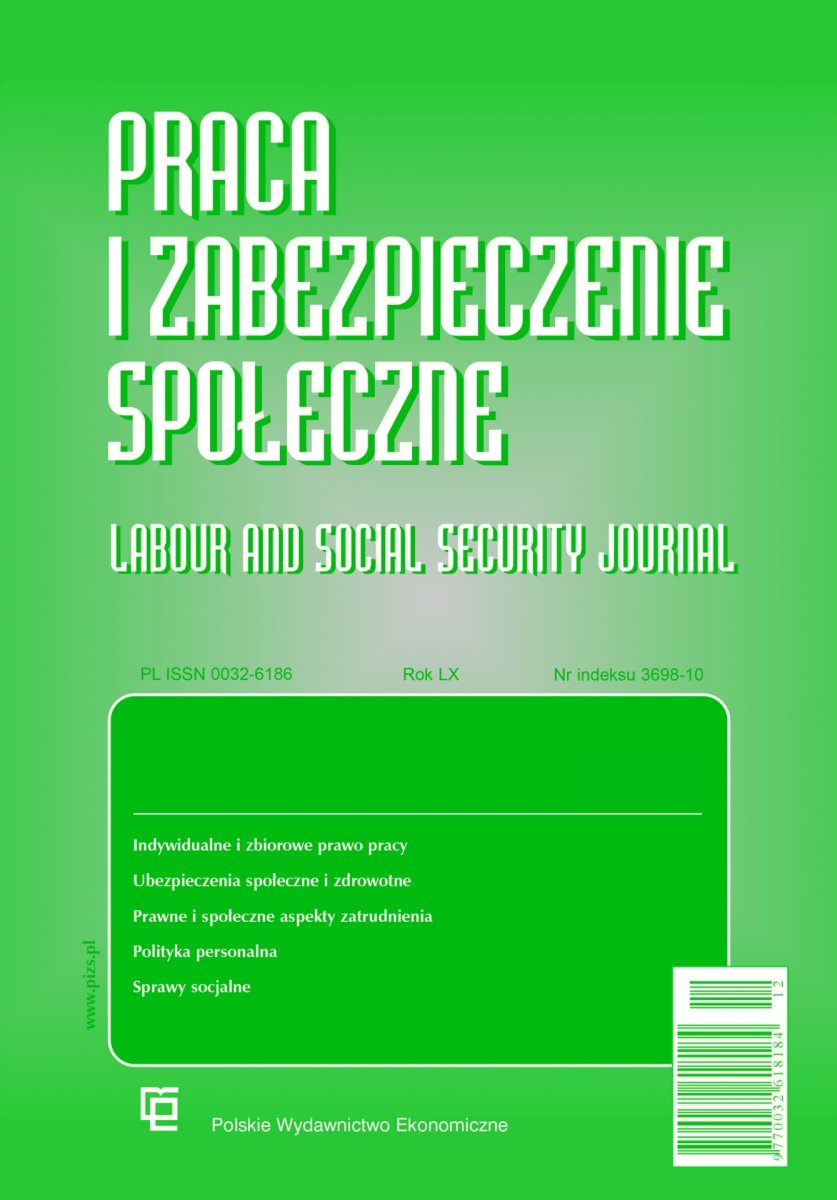
Labour and Social Security Journal 02/2026

ISSN: 0032-6186
Pages: 69
Publication date: 2026
Place publication: Warszawa
Binding: paperback
Format: A4
Article price
As file to download
5.00
Buy article
Price of the magazine number
19.00
Annual subscription 2026 (12 consecutive numbers)
225.00 €
180.00
Lowest price in last 30 days: 180.00
225.00 €
180.00
Lowest price in last 30 days: 180.00
From number:
Semi-annual subscription 2026 (6 consecutive numbers)
113.00 €
102.00
Lowest price in last 30 days: 101.00
113.00 €
102.00
Lowest price in last 30 days: 101.00
From number:
DOI: 10.33226/0032-6186.2026.2.2
JEL: K31

Recently, the development of artificial intelligence tech­nologies has resulted in more and more widespread auto­mation of the process of collecting biometric data (includ­ing image) and the development of intelligent algorithms. This development is largely supported by the increasingly widespread use of artificial intelligence (AI) in individual identification processes, enabling better and more accu­rate results when processing biometric data. However, the use of various biometric techniques and the processing of data in this way on a mass scale raises legal and ethical concerns and raises questions about the validity and ne­cessity of exercising “biometric control” over society. The processing of biometric data undoubtedly requires the application of increased protection standards because it is associated with an increased risk of violating the rights and freedoms of employees. This risk materializes especially in the context of discrimination and violation of personal rights. However, employers’ rights arising from the em­ployment relationship may not violate the personal rights of employees.

Keywords: protection of employees; personal goods; new technologies; biometric systems; biometric data
DOI: 10.33226/0032-6186.2026.2.3
JEL: J30, J39, J50, K31

The purpose of this article is to present the most important characteristics of two models of remuneration for work, developed in the Labor Code during the half-century of its validity. The topic will be presented using formal-dog­matic and statistical methods. The original model was cen­tralized, strongly influenced by the socialist system. The current model, on the other hand, focuses on dialogue be­tween social partners. The issue discussed is important not only in terms of substantive law. It also plays a significant role in the social dimension. The author therefore diag­noses the current reality of determining remuneration for work according to the established and currently applica­ble model. In doing so, he attempts to assess the extent to which the current model is reflected in practice.

Keywords: remuneration for work; social partners; collective agreements; remuneration regulations
DOI: 10.33226/0032-6186.2026.2.4
JEL: K31, J24, J83, O33

The aim of the article is to analyse employer liability for mobbing under Article 94³ of the Polish Labour Code, with particular emphasis on the significance of the perpetrator’s degree of fault and the victim’s sense of satisfaction in de­termining the amount of compensation for non pecuniary loss. The authors argue that the current legislation allows for a systematic separation of claims: compensation for non pecuniary loss should serve solely to remedy non material damage, whereas compensation for pecuniary loss should cover financial damage. They also advocate for the elimina­tion of the requirement of health impairment as a condition for awarding compensation for non pecuniary loss. The ar­ticle examines the legislative proposal UD183, which—by introducing a minimum threshold and assigning a punitive and preventive function—leads to a significant systemic shift, transforming compensation for non‑pecuniary loss in labour law into a sanction‑like instrument, raising concerns about its consistency with civil law principles.

Keywords: mobbing; compensation for pecuniary loss; pecuniary compensation
DOI: 10.33226/0032-6186.2026.2.5
JEL: J28; I18; C81; O38; K32

The article addresses the registration and analysis systems of workplace accidents in Poland, highlighting significant discrepancies in the data collected by various institutions (the National Labour Inspectorate, the Central Statistical Office, and the Social Insurance Institution). It emphasiz­es the need for digitization and standardization of proce­dures to improve the quality and reliability of the gathered information. The aim of the article is to present a proposal for an integrated system for recording and analyzing work­place accident data in Poland, which, through digitiza­tion, standardization, and the use of modern data analysis methods, will eliminate statistical discrepancies, improve the identification of accident causes, and enhance the ef­fectiveness of preventive measures. The study employed a comparative analysis of existing reporting systems, a literature review, and a proposal for a new information model that utilizes advanced data analysis and text mining techniques. The results indicate that the implementation of a unified database and standardized reporting methods can eliminate statistical inconsistencies, allowing for better identification of accident causes and improving the effec­tiveness of preventive actions.

Keywords: accidents at work; data analysis; information system; accident prevention
DOI: 10.33226/0032-6186.2026.2.6
JEL: K31

An employee filing an appeal to a labor court against a no­tice of termination of an employment contract or a notice of immediate termination of an employment contract may obtain legal protection before the final conclusion of the proceedings and the issuance of a court ruling. The legisla­ture’s tendency to strengthen the protection of the perma­nence of an employment relationship is demonstrated by the newly introduced provision of Article 7555 of the Code of Civil Procedure and the amendment to Article 4772 § 2 of the Code of Civil Procedure. The main purpose of both regulations is to eliminate the effects of reinstatement of employees who are particularly protected against termina­tion by the obligation to pay remuneration for the entire period of unemployment after a long-term legal process, as well as to counteract lengthy legal proceedings that weaken the substantive guarantees of employee rights protection. The newly introduced provision of Article 7555 of the Code of Civil Procedure allows for the provision of security to an employee by ordering the employer to employ them until the final conclusion of the proceedings, even before the fi­nal judgment of the court of first instance is issued. The au­thor also conducted a survey of court case law regarding the application of Article 7555 of the Code of Civil Procedure. The aim of the analysis is to assess the existing regulations in terms of their effectiveness from the perspective of im­plementing the protective function of procedural labor law.

Keywords: securing claims in employment matters; specially protect¬ed employees; order for continued employment; labor court; civil proceedings
DOI: 10.33226/0032-6186.2026.2.7
JEL: K31

This article attempts to interpret and analyze the applica­tion of Article 39 of the Labor Code in the context of the prohibition on terminating a fixed-term employment con­tract that expires before the employee reaches retirement age. The doubts that prompted the authors to analyze this issue stem from discrepancies in the Supreme Court’s case law and a tendency to limit the protection afforded by Article 39 of the Labor Code exclusively to employees of pre-retirement age employed under open-ended con­tracts. The question of the legitimacy of maintaining this restrictive interpretation formed the basis for a multifac­eted examination of this issue. Based on their analysis, the authors concluded that the function of Article 39 of the Labor Code—regardless of the length of the employee’s insurance record—is to protect the employee’s terms of employment, which begins upon reaching pre-retirement age and lasts for four years, regardless of the type of em­ployment contract.

Keywords: pre-retirement protection; prohibition of termination; fixed-term employment contract
DOI: 10.33226/0032-6186.2026.2.8
JEL: K31

This article provides a legal analysis of employee outsourc­ing as one of the atypical forms of employment present in the contemporary labour market. Particular attention is given to situations in which outsourcing – understood as the delegation of tasks to an external entity, often in­volving the transfer of workers and the performance of work within the client’s organisational structure – may lead to the circumvention of labour law provisions and to the recharacterization of the de facto legal relationship as an employment relationship. Drawing on case law, le­gal scholarship and principles of legal interpretation, the article identifies the boundaries of legality in so-called employee outsourcing and the legal risks associated with its misuse. The aim of the publication is not only to of­fer a doctrinal and case-law analysis, but also to formulate practical conclusions for businesses relying on external service providers.

Keywords: employee outsourcing; employment relationship; form of employment
DOI: 10.33226/0032-6186.2026.2.9
JEL: K31

The author discusses the latest Supreme Court ruling concerning the interpretation of Article 82 of the Health Insurance Act. The Court explains the rules for paying health insurance contributions by insured persons con­ducting non-agricultural business activities through sever­al companies.

Keywords: health insurance; health insurance contributions; types of non-agricultural business activity
Odbiór osobisty 0 €
Inpost Paczkomaty 3 €
Kurier Inpost 3 €
Kurier FedEX 3 €
Free delivery in Reader's Club from 47 €