
Best prices Special offers for members of the PWE book club The cheapest delivery

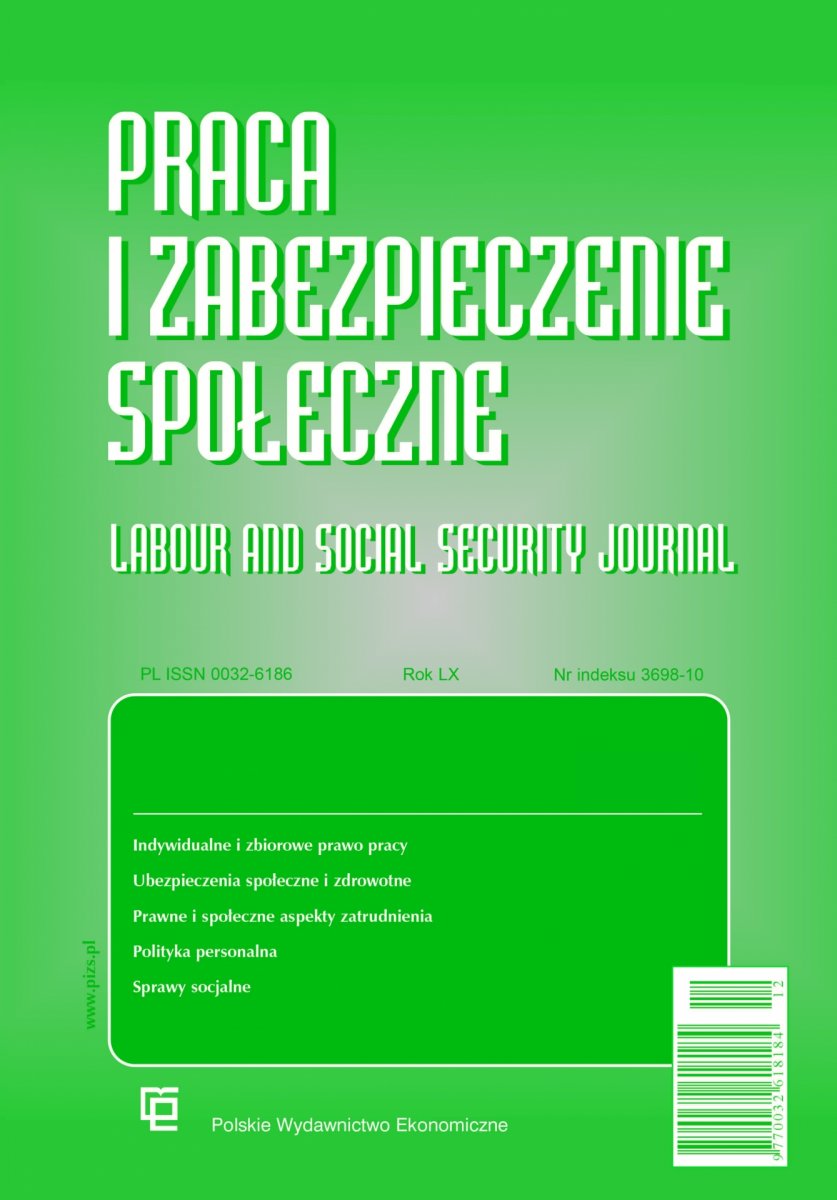
Labour and Social Security Journal 10/2025

ISSN: 0032-6186
Pages: 61
Publication date: 2025
Place publication: Warszawa
Binding: paperback
Format: A4
Article price
As file to download
5.00
Buy article
Price of the magazine number
19.00
Annual subscription 2026 (12 consecutive numbers)
225.00 €
180.00
Lowest price in last 30 days: 180.00
225.00 €
180.00
Lowest price in last 30 days: 180.00
From number:
Semi-annual subscription 2026 (6 consecutive numbers)
113.00 €
102.00
Lowest price in last 30 days: 101.00
113.00 €
102.00
Lowest price in last 30 days: 101.00
From number:
DOI: 10.33226/0032-6186.2025.10.2
JEL: K00, K10, K31

The purpose of the paper is to address ongoing disputes regarding the interpretation of labor law. The authors aim to explore whether the method of enacting normative acts affects the interpreter’s goals during the interpretation process. Some literature suggests that when they are en­acted through agreement (such as labor collective agree­ments), in contrast to acts not enacted in this manner, the interpreter should prioritize the actual intentions of the parties involved over the literal meaning of their provi­sions. The authors argue that there is no difference in this regard among various normative acts. In all cases, the au­thor’s intention is what interpreters seek.

Keywords: legal interpretation; interpretation of the agreements; labor law; labor collective agreements; legislative intent
DOI: 10.33226/0032-6186.2025.10.3
JEL: J51, J52, J58, K31

This article examines the permissibility of proxy voting during decision-making body meetings in trade unions. The analysis concludes that de lege lata, proxy participation and voting are legally admissible unless explicitly prohib­ited by the union’s statutes. However, the study highlights that the excessive use of proxy mechanisms risks enabling small, concentrated groups to dominate decision-making processes, thereby undermining internal union democra­cy. Furthermore, the article explores the potential of elec­tronic communication tools as an alternative to traditional proxy practices. Such digital solutions could enhance ac­cessibility and engagement of rank-and-file union mem­bers who are unable to attend meetings in person, foster­ing broader participation and strengthening democratic governance within labor organizations.

Keywords: trade union; voting; plenipotentiary; democracy
DOI: 10.33226/0032-6186.2025.10.4
JEL: K31

The parties to an employment contract may terminate the contract by mutual agreement. Termination of employ­ment under Article 30 § 1(1) of the Labour Code, on the one hand, raises numerous questions and doubts in practice, and on the other hand, is not a frequent topic of discussion in the literature and case law. This dissonance means that the discussed method of terminating an employment con­tract requires attention. In particular, it is unclear wheth­er the mutual agreement on the date of termination of the employment contract is a necessary provision, or wheth­er it can be assumed that in each case its absence means consent to the termination of the obligation on the date of conclusion of the agreement. Similarly problematic is the transfer of the regulation concerning defects in declarations of intent to labour law. The question arises as to whether this construction should be applied directly or whether its modification is permissible, and if so, to what extent. The Supreme Court has spoken on the above-mentioned issues, but its statements are, on the one hand, innovative and, on the other hand, not necessarily consistent with each other. It seems that there is a need to review and organise them.

Keywords: agreement between the parties; defects in declarations of intent; date of termination of employment
DOI: 10.33226/0032-6186.2025.10.5
JEL: K31

The article is dedicated to an issue involving ending re­mote work and reinstatement to work under previous con­ditions. It has a character of de lege lata and de lege ferenda. A very important role in the described topic is played by regulations stipulated in art. 6719 § 4 and 5; art. 6722 § 1 and 2; art. 6728 § 3; art. 6731 § 7; and art. 1881 § 6 of the Labor Code, since they specify the coded procedures re­ferring to ending remote work and reinstatement to work under previous conditions. The analysis of the above-men­tioned provisions should be conducted with reference to the statutory framework within which remote work may be implemented. I mean the use of remote work in ac­cordance with 6719 § 1 sec. 1 and 2 and § 3 and 6 of the Labor Code; art. 6733 § 1, and art. 1881 § 1 and 2 of the Labor Code. In the conclusion of the considerations made in this study I deduce that the parties to an employ­ment contract use a broad range of rights de lege lata re­garding ending remote work and reinstatement to work under previous conditions.

Keywords: remote work; remote work procedure pursuant to the Labor Code; ending remote work; reinstatement to work under previous conditions; legally binding application
DOI: 10.33226/0032-6186.2025.10.6
JEL: K31

The article examines the regulatory framework governing the employee’s right to the protection of family life under international law and European Union law. Its objective is to assess the extent to which existing legislative instruments — in particular Article 8 ECHR, the ICCPR, ILO conven­tions, Council of Europe standards and EU secondary legis­lation — provide effective protection of workers’ family life. The article presents the principal legal regulations and the relevant lines of jurisprudence relating to the protection of the employee’s right to family life, indicating both the scope of state obligations and the nature of the rights conferred on workers.

Keywords: family life; employee rights; international law; European Union law; labour law
DOI: 10.33226/0032-6186.2025.10.7
JEL: K55

The purpose of this article is to discuss the legal con­sequences of the Constitutional Tribunal’s judgment of 6 June 2024 in case SK 140/20 (OTKA-A 2024/67). Fol­lowing its assessment of the constitutionality of Article 25, Section 1b of the Pension Act, the Constitutional Tribu-nal agreed with the findings of its previous judgment of 6 March 2019 in case P 20/16 (OTK-A 2019/11) and found that the principle of citizens’ trust in the state and its laws had been violated. The Constitutional Tribunal’s ruling equalizes the legal status of all individuals ag­grieved by a legal norm deemed unconstitutional in the area of the right to a public pension. This article will out­line the possible choices available to insured persons to pursue the appropriate legal basis for restitution of the constitutional status quo. The article will also address the need for urgent adoption of substantive regulations equalizing the situation of “all persons aggrieved” by the application of the legal norm of Article 25, Section 1b of the Pension Act.

Keywords: universal pension; early retirement pension; Constitutional Tribunal judgment; unconstitutionality of provisions
DOI: 10.33226/0032-6186.2025.10.8
JEL: K31

The article addresses the issue of an employee’s control in the context of drugs acting similarly to alcohol. The au­thors focus on the analysis of the concept “drugs acting similarly to alcohol” and methods of testing for the pres­ence of these substances in the bodies of employees. They assume that the limited scope of the employer’s control competences makes it difficult to verify the employee’s compliance with the duty of sobriety and, as a result, to apply specific legal consequences to the employee.

Keywords: the employee; duty of sobriety; drug acting similarly to alcohol; on-site screening instrument for drugs in samples; oral fluid
DOI: 10.33226/0032-6186.2025.10.9
JEL: K31

The author discusses the latest Supreme Court ruling on the criteria for qualifying mobbing (Article 943 § 2 of the Labour Code). This ruling explains the premise of the persistence of the mobber's actions and considers whether mobbing can be committed through unintentional fault.

Keywords: mobbing; unintentional fault
Odbiór osobisty 0 €
Inpost Paczkomaty 3 €
Kurier Inpost 3 €
Kurier FedEX 3 €
Free delivery in Reader's Club from 47 €